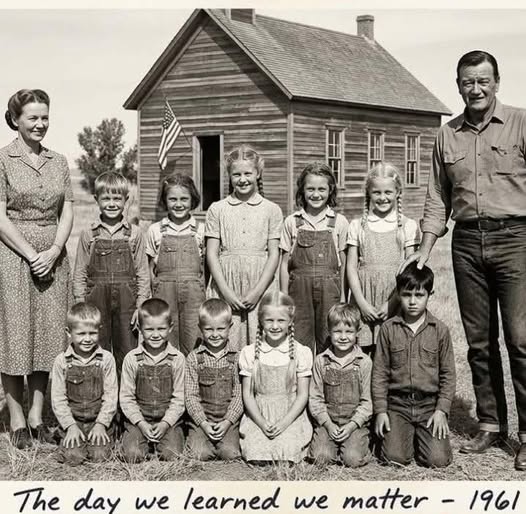
March 1961, a school teacher in rural Montana asks her 12 students to write one sentence to John Wayne. It’s just a classroom activity. She doesn’t expect him to respond. Two weeks later, a delivery truck arrives at the one room schoolhouse. What’s inside will transform how these children see America. Here is the story.
The letter arrives on a Tuesday. John Wayne’s office in Hollywood gets hundreds of letters every week. fan mail, requests, scripts, business proposals. Most get sorted by assistance, answered with form letters, signed photos, the usual routine. But this one is different. The envelope is plain, handressed, Montana postmark.
Inside, three pages, lined notebook paper, teacher’s handwriting, neat, careful. The letter starts simply, “Dear Mr. Wayne, my name is Margaret. I teach at a small school in Montana. 12 students, ages 6 to 14. Most are ranchers’ children. We study your films to learn about American history and values. Wayne reads that line twice. Studies his films for history, for values. He’s made a hundred westerns.
Never thought of them as textbooks. The letter continues, “We have no film projector, so we read your scripts aloud. The children act out scenes. It’s not the same as seeing you on screen, but it helps them understand courage, honor, and what it means to be American. Wayne sets down his coffee, keeps reading.
I’m writing to ask if you might have any advice for teaching children about these values. We’re just a small school, far from anywhere important, but I believe these lessons matter, especially for children growing up in places people forget about. Then at the bottom, 12 messages, one from each student, written in children’s handwriting.
Some shaky, some barely legible, but all sincere. Dear Mr. Wayne, you are the bravest cowboy. Sarah, age seven. Mr. Wayne, my dad says you’re a real American. I want to be like you. Billy, age 10. I watch your movies when they come to town. You never give up. Tommy, age 8. 12 messages, 12 children somewhere in Montana learning about America from scripts read aloud in a one- room schoolhouse.
Wayne folds the letter, puts it in his desk drawer, sits there thinking, “Before we continue, quick question for you. Tell me where you watch from. Let’s see which place has the most fans of the Duke.” It’s March 15th, 1961. Wayne is 53 years old, made 60 westerns, maybe more. Lost count. Some good, some forgettable, but never thought of them as lessons, as teaching tools, as something that mattered beyond entertainment.
Now 12 children in Montana are acting out his scripts, learning values, growing up believing in something because of movies he made. He calls his business manager. How much would a good film projector cost? For what? for a school depends on 16 mm, maybe $300. Get one best quality and get prints of 10 of my films. My best ones.
Stage coach. Red River. She wore a yellow ribbon. Fort Apache. Rio Grand. The best teaching ones. Duke. What’s this for? A school in Montana. They ask for this? No, but they need it. Wayne writes a check, $500, makes it out to the school. No name, just Montana school, Margaret’s class.
Then he sits down and writes a letter. One letter for all of them, teacher and students together. He writes for an hour, crosses out lines, starts over, finally gets it right. Dear Margaret and students, thank you for your letter. I’m honored that you study my films. more honored than you know. You asked for advice about teaching values. Here’s what I believe.
Courage isn’t the absence of fear. It’s doing what’s right even when you’re scared. Honor is keeping your word even when nobody’s watching. Being American means believing everyone matters. Even people in small towns far from anywhere. I’m sending you a projector and some films. Not because you asked, but because students like you deserve to see stories on screen, not just read them.
You’re not just 12 kids in Montana. You’re 12 Americans. That’s everybody. Keep studying. Keep learning. Keep believing in something bigger than yourselves. That’s what makes this country work. Your friend, Duke, seals the letter, ships it with the projector and films. Don’t tell anyone. Doesn’t make it publicity.
just sends it and moves on to the next picture. 6 months later, Wayne is in Montana filming How the West was one. Big production, multiple directors, epic western. They’re shooting in the mountains, beautiful country, cold, remote, middle of nowhere. One day, there’s no filming, weather delay, and rain. The crew sits around, playing cards.