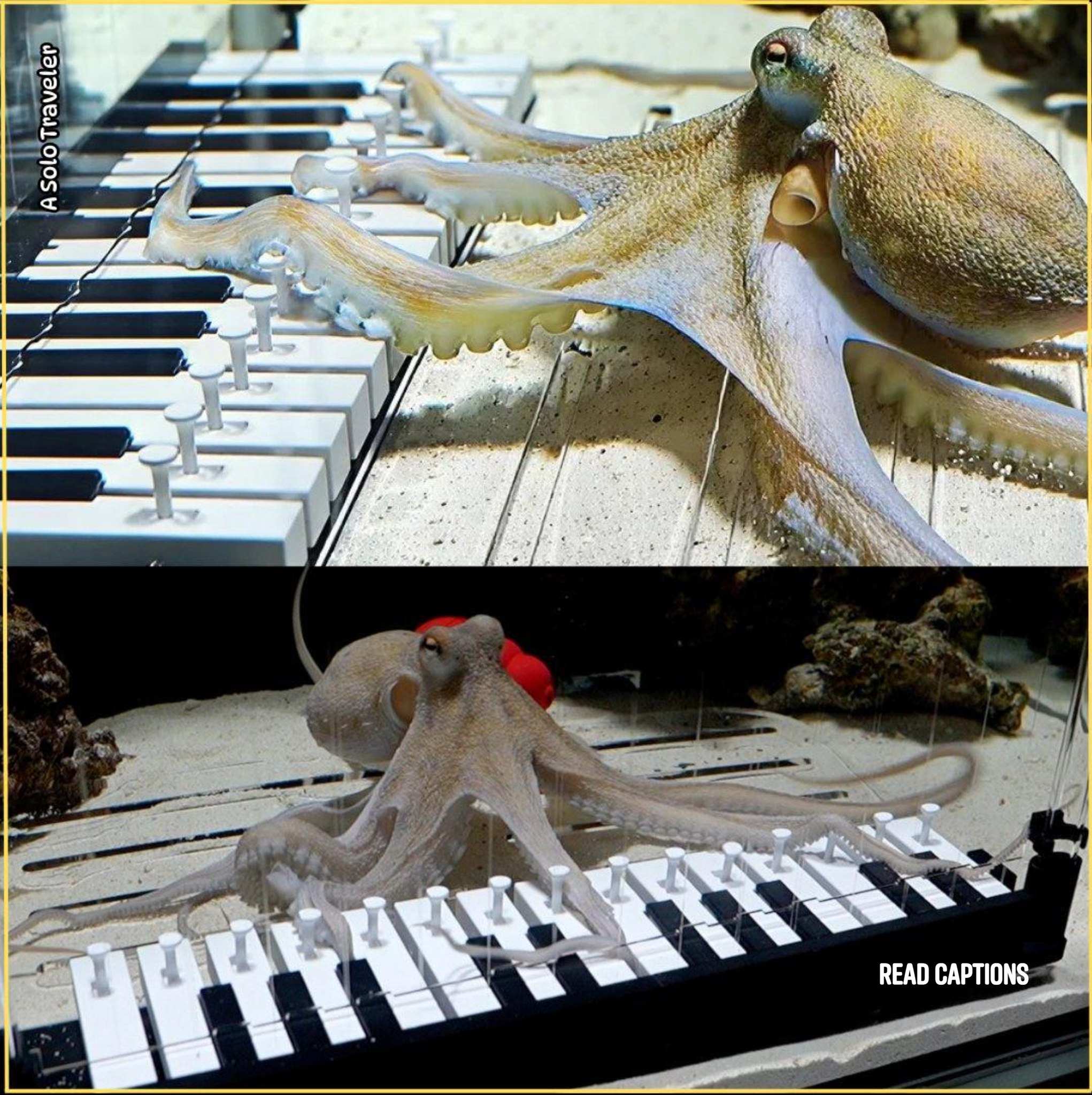
For six months, Swedish YouTuber Mattias Krantz worked on what he half-jokingly called “probably the worst thing I’ve ever done and maybe the coolest.” After rescuing an octopus from a Portugal fishery, he named him Takoyaki, Tako for short and set himself a strange goal: teach an octopus to play piano.
Not metaphorically. Literally.
Krantz designed a custom underwater keyboard, with levers sized for tentacles instead of fingers. Each key, when pressed, triggered a sound above water. To motivate learning, he built a “crab elevator”—a reward system that lowered Tako’s favorite treat a little closer every time the right note was played.
It wasn’t smooth. Most days were trial, error, and resetting expectations. Octopuses are famously intelligent but also independent. They don’t obey. They negotiate. Sometimes they ignore you completely.
Then something clicked.
Over time, Tako learned a six-note progression, reliably pulling the correct levers in sequence. Krantz began accompanying him on guitar. What started as enrichment turned into something like a jam session. “I can’t believe I sit here and play with an octopus,” Krantz later told The Washington Post.
Scientists have long known that octopuses possess remarkable cognition: problem-solving, memory, curiosity, and even play. What this experiment shows isn’t that Tako understands music the way humans do but that he can learn structured tasks, associate actions with outcomes, and engage with novel tools.
And that matters.
Because octopuses are often reduced to food or curiosities behind glass. Seeing one interact, learn, and participate forces a reconsideration of how we relate to intelligence that doesn’t look like ours.
This wasn’t about turning an animal into entertainment.
It was about asking a question few people think to ask:
What happens when curiosity meets patience,
and intelligence answers back with a tentacle?
It sounds like a dare that went too far. Or the start of a science-fiction fable.
See less