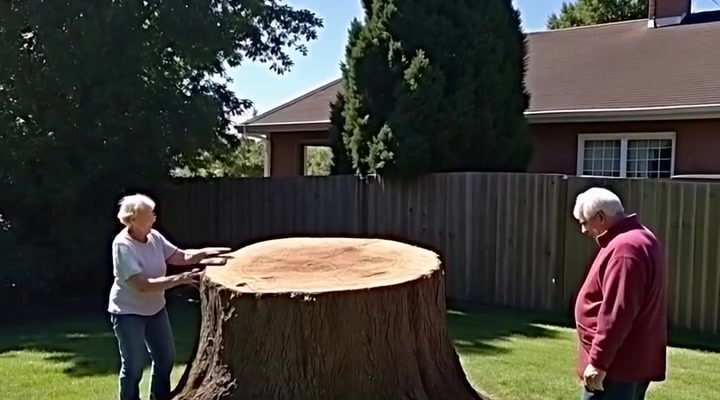
The lights cast long shadows across his yard, illuminating a newly empty space where once our tree’s branches had reached over the fence. There was a sinking feeling in my stomach; an unspoken tension hung heavy in the air. My parents exchanged glances, each knowing what the other was thinking but neither wanting to voice it. Mr. Collins had lied.
We sat at the kitchen table, the glow of the laptop screen highlighting my father’s furrowed brow. The footage was paused on Mr. Collins’ smiling face, a picture of deceit we couldn’t reconcile with the genial man we’d known for years. It felt like betrayal—not just the loss of the tree, but the erosion of trust with someone who lived just a stone’s throw away.
“We can’t let this go,” my mother said, her voice resolute. “That tree meant something. It was part of our family history.”
My father nodded, the lines on his forehead deepening. “We’ll need to report this to the authorities,” he said. “It’s not just about the tree; it’s about what’s right.”
The next morning, we visited the city’s municipal office. With copies of the footage and a detailed account of what had happened, we laid our case before a sympathetic official. She listened attentively, her expression shifting from mild curiosity to concern as the story unfolded.
“Property disputes can be messy,” she admitted, “but the unauthorized removal of a tree is another matter. We’ll investigate this.”
Back home, we tried to go about our usual routines, but the absence of the tree was a constant reminder of both loss and injustice. The backyard, once a haven of dappled sunlight and leafy whispers, felt exposed and empty. The tree had been more than just wood and leaves; it had been a guardian, a storyteller, a living piece of history.
Days passed without word from the city or any sign of remorse from Mr. Collins. His backyard remained a tranquil facade, his daily routine unchanged. But on the inside, we were restless. Waiting.
Then, unexpectedly, there was a knock at our door. It was the city official, accompanied by a man in a suit who introduced himself as a mediator specializing in neighborhood disputes. They had spoken to Mr. Collins, and he had admitted to hiring the men—claiming he believed the tree posed a risk to his property.
“He thought he was doing the right thing,” the mediator explained. “But he’s agreed to make amends.”
The offer was a reparation: a new tree, of our choosing, planted at no cost to us. It wouldn’t replace the decades lost, but it was something. A start. A gesture of goodwill in a situation fraught with bad faith.
We accepted, not because it was enough, but because sometimes moving forward is the only option. The new tree—a young sapling with potential—was planted that weekend. It would take years to reach the height and majesty of its predecessor, but it was a reminder that while things may be cut down, they can also grow again.
As we watched the sapling sway gently in the breeze, I realized that our roots, like those of the trees, ran deep. They could withstand storms and betrayals. And though the landscape had changed, the spirit of resilience remained.