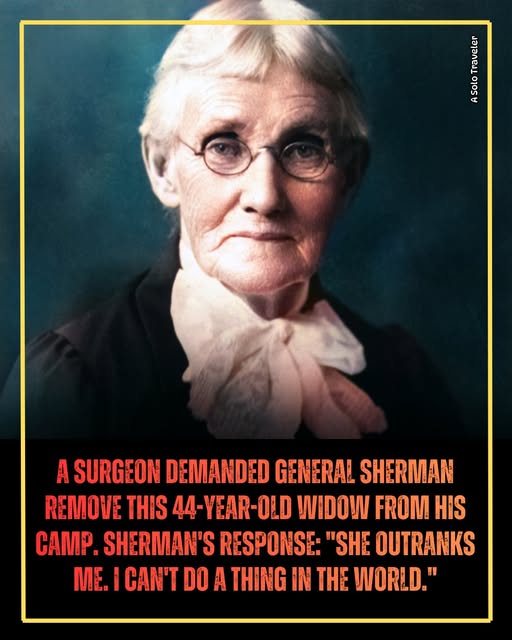
The complaint reached William Tecumseh Sherman.
Sherman’s reply became legend:
“She outranks me. I can’t do a thing in the world.”
Mary Ann Bickerdyke was not an officer. She had no medical degree, no military rank, and no official authority of any kind.
In 1861, she was a widow living in Galesburg, Illinois, raising two sons after her husband’s death. To survive, she practiced “botanic medicine,” relying on herbal remedies and hands-on care. She lived an ordinary life, far from battlefields or power.
Then one Sunday, her pastor read a letter aloud during church.
A young doctor from their town had written from Cairo, Illinois, where Union troops were stationed. He described scenes of misery. Soldiers were dying not from gunshots, but from filth, disease, malnutrition, and neglect. Hospitals were chaotic. Supplies were missing. Men were rotting in their beds.
The congregation gathered donations, raising $500. All they needed was someone willing to deliver the supplies.
Mary Ann raised her hand.
She believed she would make the delivery and return home.
She did not come back for four years.
What she found at Cairo enraged her. Wounded men lay on dirty straw. There was no clean water, no proper food, and little concern for sanitation. Infections spread freely. Soldiers died from conditions that basic hygiene could have prevented.
Mary Ann did not wait for permission.
She took over.
She scrubbed hospital floors herself until they were clean. She organized kitchens and insisted soldiers be fed nourishing meals. She created laundries so men could have clean clothing and bedding. She assisted in surgeries, comforted the dying, and wrote letters home for soldiers too weak to hold a pen.
When supplies were locked away while men suffered, she broke the locks.
When surgeons refused to do their jobs or endangered patients through negligence, she had them removed.
When officers questioned her authority, she answered bluntly:
“I have received my authority from the Lord God Almighty. Have you anything that outranks that?”
They did not.
Word of “Mother Bickerdyke” spread rapidly through Union camps. Soldiers trusted her completely. Many later said she saved their lives, not only through medical care, but by refusing to let bureaucracy decide who lived and who died.
She walked battlefields at night carrying a lantern, searching for wounded men left behind after fighting ended. Often, she was the only woman moving through the wreckage, organizing field hospitals amid chaos and bloodshed.
Her reputation reached the highest command.
Ulysses S. Grant gave her full support and a pass allowing her free travel anywhere under his authority. Sherman defended her fiercely and later called her “one of his best generals.”
When a surgeon complained to Sherman and demanded her removal, Sherman simply refused. He understood what everyone else already knew.
Mary Ann Bickerdyke answered to results.
She served at nineteen major battles, including Fort Donelson, Shiloh, Vicksburg, Chattanooga, and Sherman’s March to the Sea. Under her supervision, more than 300 field hospitals were established.
When the war ended in 1865, she finally left the camps.
But she never stopped serving.
For decades, she helped Union veterans secure pensions, advocated for disabled soldiers, assisted homesteaders in Kansas, and worked with the Salvation Army. She continued caring for others until the end of her life.
Mary Ann Bickerdyke died on November 8, 1901, at age 84.
Today, a statue in Galesburg, Illinois shows her kneeling beside a wounded soldier, offering him water.
She had no rank, no degree, and no official command.
Yet generals deferred to her.
Because when lives were on the line, she did not ask what she was allowed to do.
She did what needed to be done