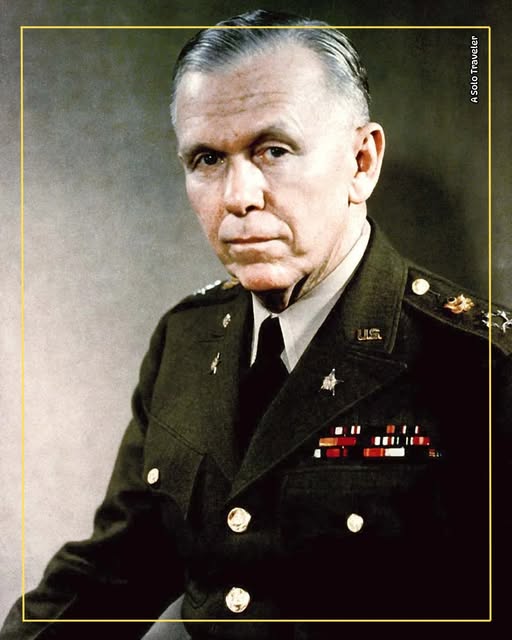
That’s what President Roosevelt told George Marshall when explaining why he wouldn’t be commanding D-Day the operation Marshall had spent years planning, the assignment every general dreamed of leading.
Instead, Roosevelt gave it to Eisenhower. And Marshall, without complaint, went back to his desk in Washington.
He was the most powerful military organizer in American history. Under his direction, the U.S. Army grew from fewer than 200,000 men to 8.3 million—a forty-fold increase in three years. Winston Churchill called him “the organizer of victory.”
But Marshall had never actually led troops in combat. He worked behind the scenes. No glory. No headlines. Just the machinery of war running smoothly because one man refused to let it break down.
When Roosevelt kept asking him to state his preference for the D-Day command, Marshall kept refusing to lobby for himself.
“I wanted him to feel free to act in whatever way he felt was to the best interests of the country,” Marshall later recalled, “and not to consider my feeling in any way. I would cheerfully go whatever way he wanted me to go.”
Roosevelt chose Eisenhower. Eisenhower became the most famous general of World War II. Marshall stayed in Washington and won the war anyway.
Then he did something even harder.
He tried to win the peace.
June 5, 1947. Harvard University. Marshall, now Secretary of State, stood before a commencement crowd of 15,000 and delivered an eleven-minute speech that would reshape the twentieth century.
Even Harvard’s president didn’t know what was coming. The State Department had told reporters it would be “a routine commencement speech—nothing of any importance.”
It was the most important commencement address ever given at Harvard.
Marshall proposed the European Recovery Program—soon known as the Marshall Plan. The United States would pour $13 billion into rebuilding the shattered economies of Western Europe. That’s roughly $135-150 billion in today’s dollars.
Not just allies. Enemies too.
Germany. Italy. The same nations that had bombed London, conquered France, and sworn to destroy American democracy.
“Our policy is directed not against any country or doctrine,” Marshall said, “but against hunger, poverty, desperation, and chaos.”
He had seen what desperation breeds. After World War I, the Treaty of Versailles had crushed Germany with punitive reparations. From that economic collapse rose the Third Reich. Marshall refused to let history repeat.
The plan faced opposition. But Marshall’s integrity—built over decades of service—carried the day. Senators who trusted few people trusted George Marshall. The Economic Cooperation Act passed: 69-17 in the Senate, 329-74 in the House.
Over the next four years, Western Europe transformed.
Industrial production surged. Cities rose from rubble. Former enemies became trading partners, then allies. Germany and Italy joined the democratic West. The European Coal and Steel Community formed—the seed that would become the European Union.
The Marshall Plan didn’t just rebuild economies. It rewrote the rules of how victors treat the vanquished.
In October 1953, Marshall learned he had won the Nobel Peace Prize. He was bedridden with the flu. His response was typical: he told the press the award was really “a tribute to the American people.”
He became the first—and still the only—professional soldier in history to receive the Nobel Peace Prize.
Some protested. At the ceremony in Oslo, three men rushed the balcony, dropping handbills accusing him of war crimes, screaming “Murderer!”
Marshall looked up calmly. King Haakon VII of Norway and the entire audience rose to their feet and gave him a thunderous standing ovation.
In his acceptance speech, Marshall addressed the controversy head-on:
“There has been considerable comment over the awarding of the Nobel Peace Prize to a soldier. I am afraid this does not seem as remarkable to me as it quite evidently appears to others. The cost of war in human lives is constantly spread before me, written neatly in many ledgers whose columns are gravestones. I am deeply moved to find some means or method of avoiding another calamity of war.”
Marshall retired to his home in Leesburg, Virginia. He wrote no memoirs. He gave no lectures. He sought no further recognition.
He died on October 16, 1959, after a series of strokes. He was buried at Arlington National Cemetery.
His legacy?
The rebuilt cities of Europe. The alliance that kept the peace. The demonstration that mercy could be stronger than revenge.
When Marshall visited Westminster Abbey for Queen Elizabeth II’s coronation in 1953, the entire congregation rose to their feet as he walked down the aisle. He looked behind him to see who the dignitary was. Then he realized they were standing for him.
He was the only non-royal seated at the Queen’s table that night.
George C. Marshall never sought glory. He built the greatest army in American history, then used America’s fortune to save the enemies that army had defeated.
True power isn’t domination. It’s the courage to heal what hatred destroyed.